Pre-Winter Limited Time 70% Discount Offer - Ends in 0d 00h 00m 00s - Coupon code: cramtick70

Databricks-Generative-AI-Engineer-Associate Databricks Certified Generative AI Engineer Associate Questions and Answers

Questions 4

A company selling gourmet mushroom-growing supplies has a script that runs once per day to scrape various social media platforms for posts that mention its name. The scraped text data is loaded into a Delta table each night for a downstream processing task that summarizes each post and its sentiment for internal use. Given the small size of the company, it only receives a couple hundred posts per day.

Which solution best optimizes for cost and ease of implementation?

Options:

A.

Schedule a nightly job to call OpenAI’s batch inference API, save the results, and terminate the cluster.

B.

Schedule a nightly SQL query with ai_query() calling a pay-per-token endpoint.

C.

Schedule a nightly SQL query with ai_query() calling a provisioned-throughput endpoint.

D.

Schedule a nightly job that runs a notebook to download the model locally, process the records, and terminate the cluster.

Buy Now
Questions 5

A Generative Al Engineer interfaces with an LLM with prompt/response behavior that has been trained on customer calls inquiring about product availability. The LLM is designed to output “In Stock” if the product is available or only the term “Out of Stock” if not.

Which prompt will work to allow the engineer to respond to call classification labels correctly?

Options:

A.

Respond with “In Stock” if the customer asks for a product.

B.

You will be given a customer call transcript where the customer asks about product availability. The outputs are either “In Stock” or “Out of Stock”. Format the output in JSON, for example: {“call_id”: “123”, “label”: “In Stock”}.

C.

Respond with “Out of Stock” if the customer asks for a product.

D.

You will be given a customer call transcript where the customer inquires about product availability. Respond with “In Stock” if the product is available or “Out of Stock” if not.

Buy Now
Questions 6

A Generative AI Engineer is building a multi-turn chat app with LangGraph on Databricks. The app must persist chat history—messages, roles, timestamps, and session IDs—for many concurrent users, support SQL queries, and stay governed in Unity Catalog. The engineer also wants ACID guarantees, low-latency reads and writes, and an easy way to sync chat data into Delta tables for analytics and model training.

Which approach fits these requirements?

Options:

A.

Store conversation history in MLflow runs and retrieve it via the MLflow Tracking API inside LangGraph nodes.

B.

Use Lakebase with a chat_history table wired to a Postgres-backed LangGraph checkpoint/memory component and enable synchronization from Lakebase into Delta tables.

C.

Write each turn from a custom LangGraph node directly into a Delta table with Spark append, then query history via Spark SQL on every request.

D.

Use a custom in-memory LangGraph state store running on the Databricks cluster driver, and periodically snapshot the state to JSON files in DBFS.

Buy Now
Questions 7

A Generative AI Engineer is building an LLM to generate article summaries in the form of a type of poem, such as a haiku, given the article content. However, the initial output from the LLM does not match the desired tone or style.

Which approach will NOT improve the LLM’s response to achieve the desired response?

Options:

A.

Provide the LLM with a prompt that explicitly instructs it to generate text in the desired tone and style

B.

Use a neutralizer to normalize the tone and style of the underlying documents

C.

Include few-shot examples in the prompt to the LLM

D.

Fine-tune the LLM on a dataset of desired tone and style

Buy Now
Questions 8

A Generative AI Engineer I using the code below to test setting up a vector store:
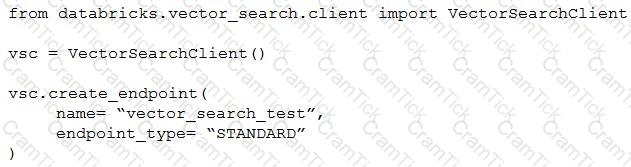
Assuming they intend to use Databricks managed embeddings with the default embedding model, what should be the next logical function call?

Options:

A.

vsc.get_index()

B.

vsc.create_delta_sync_index()

C.

vsc.create_direct_access_index()

D.

vsc.similarity_search()

Buy Now
Questions 9

An AI developer team wants to fine-tune an open-weight model to have exceptional performance on a code generation use case. They are trying to choose the best model to start with. They want to minimize model hosting costs and are using Hugging Face model cards and spaces to explore models. Which TWO model attributes and metrics should the team focus on to make their selection?

Options:

A.

Big Code Models Leaderboard

B.

Number of model parameters

C.

MTEB Leaderboard

D.

Chatbot Arena Leaderboard

E.

Number of model downloads last month

Buy Now
Questions 10

A Generative Al Engineer is building a system that will answer questions on currently unfolding news topics. As such, it pulls information from a variety of sources including articles and social media posts. They are concerned about toxic posts on social media causing toxic outputs from their system.

Which guardrail will limit toxic outputs?

Options:

A.

Use only approved social media and news accounts to prevent unexpected toxic data from getting to the LLM.

B.

Implement rate limiting

C.

Reduce the amount of context Items the system will Include in consideration for its response.

D.

Log all LLM system responses and perform a batch toxicity analysis monthly.

Buy Now
Questions 11

A Generative Al Engineer has created a RAG application to look up answers to questions about a series of fantasy novels that are being asked on the author’s web forum. The fantasy novel texts are chunked and embedded into a vector store with metadata (page number, chapter number, book title), retrieved with the user’s query, and provided to an LLM for response generation. The Generative AI Engineer used their intuition to pick the chunking strategy and associated configurations but now wants to more methodically choose the best values.

Which TWO strategies should the Generative AI Engineer take to optimize their chunking strategy and parameters? (Choose two.)

Options:

A.

Change embedding models and compare performance.

B.

Add a classifier for user queries that predicts which book will best contain the answer. Use this to filter retrieval.

C.

Choose an appropriate evaluation metric (such as recall or NDCG) and experiment with changes in the chunking strategy, such as splitting chunks by paragraphs or chapters.

Choose the strategy that gives the best performance metric.

D.

Pass known questions and best answers to an LLM and instruct the LLM to provide the best token count. Use a summary statistic (mean, median, etc.) of the best token counts to choose chunk size.

E.

Create an LLM-as-a-judge metric to evaluate how well previous questions are answered by the most appropriate chunk. Optimize the chunking parameters based upon the values of the metric.

Buy Now
Questions 12

A Generative AI Engineer is creating an agent-based LLM system for their favorite monster truck team. The system can answer text based questions about the monster truck team, lookup event dates via an API call, or query tables on the team’s latest standings.

How could the Generative AI Engineer best design these capabilities into their system?

Options:

A.

Ingest PDF documents about the monster truck team into a vector store and query it in a RAG architecture.

B.

Write a system prompt for the agent listing available tools and bundle it into an agent system that runs a number of calls to solve a query.

C.

Instruct the LLM to respond with “RAG”, “API”, or “TABLE” depending on the query, then use text parsing and conditional statements to resolve the query.

D.

Build a system prompt with all possible event dates and table information in the system prompt. Use a RAG architecture to lookup generic text questions and otherwise leverage the information in the system prompt.

Buy Now
Questions 13

After changing the response generating LLM in a RAG pipeline from GPT-4 to a model with a shorter context length that the company self-hosts, the Generative AI Engineer is getting the following error:

What TWO solutions should the Generative AI Engineer implement without changing the response generating model? (Choose two.)

Options:

A.

Use a smaller embedding model to generate

B.

Reduce the maximum output tokens of the new model

C.

Decrease the chunk size of embedded documents

D.

Reduce the number of records retrieved from the vector database

E.

Retrain the response generating model using ALiBi

Buy Now
Questions 14

A Generative Al Engineer has already trained an LLM on Databricks and it is now ready to be deployed.

Which of the following steps correctly outlines the easiest process for deploying a model on Databricks?

Options:

A.

Log the model as a pickle object, upload the object to Unity Catalog Volume, register it to Unity Catalog using MLflow, and start a serving endpoint

B.

Log the model using MLflow during training, directly register the model to Unity Catalog using the MLflow API, and start a serving endpoint

C.

Save the model along with its dependencies in a local directory, build the Docker image, and run the Docker container

D.

Wrap the LLM’s prediction function into a Flask application and serve using Gunicorn

Buy Now
Questions 15

A Generative AI Engineer is deploying a conversational agent that provides financial-analysis insights to internal analysts at a company. The company has standardized on Microsoft 365 for all internal communications and collaboration. The analysts are distributed across multiple time zones and primarily work within Microsoft Teams channels, where they already discuss financial data and share reports. The agent needs to integrate with the company’s existing Azure Active Directory for authentication and must respect the company’s data-governance policies. Users should be able to interact with the agent within their existing workflow without switching applications.

Which interface should the engineer implement for this agent deployment?

Options:

A.

Slack integration to enable the agent in a dedicated workspace for the financial-analysis team.

B.

Microsoft Teams integration to deploy the agent as a bot within Teams channels where analysts already collaborate.

C.

REST API endpoint with a custom frontend application hosted on the company’s internal portal.

D.

Databricks Apps to create a custom web application that analysts can access through their browsers with SSO authentication.

Buy Now
Questions 16

Generative AI Engineer at an electronics company just deployed a RAG application for customers to ask questions about products that the company carries. However, they received feedback that the RAG response often returns information about an irrelevant product.

What can the engineer do to improve the relevance of the RAG’s response?

Options:

A.

Assess the quality of the retrieved context

B.

Implement caching for frequently asked questions

C.

Use a different LLM to improve the generated response

D.

Use a different semantic similarity search algorithm

Buy Now
Questions 17

A Generative Al Engineer needs to design an LLM pipeline to conduct multi-stage reasoning that leverages external tools. To be effective at this, the LLM will need to plan and adapt actions while performing complex reasoning tasks.

Which approach will do this?

Options:

A.

Tram the LLM to generate a single, comprehensive response without interacting with any external tools, relying solely on its pre-trained knowledge.

B.

Implement a framework like ReAct which allows the LLM to generate reasoning traces and perform task-specific actions that leverage external tools if necessary.

C.

Encourage the LLM to make multiple API calls in sequence without planning or structuring the calls, allowing the LLM to decide when and how to use external tools spontaneously.

D.

Use a Chain-of-Thought (CoT) prompting technique to guide the LLM through a series of reasoning steps, then manually input the results from external tools for the final answer.

Buy Now
Questions 18

A Generative AI Engineer is using LangGraph to define multiple tools in a single agentic application. They want to enable the main orchestrator LLM to decide on its own which tools are most appropriate to call for a given prompt. To do this, they must determine the general flow of the code. Which sequence will do this?

Options:

A.

1. Define or import the tools 2. Add tools and LLM to the agent 3. Create the ReAct agent

B.

1. Define or import the tools 2. Define the agent 3. Initialize the agent with ReAct, the LLM, and the tools

C.

1. Define the tools 2. Load each tool into a separate agent 3. Instruct the LLM to use ReAct to call the appropriate agent

D.

1. Define the tools inside the agents 2. Load the agents into the LLM 3. Instruct the LLM to use COT reasoning to determine the appropriate agent

Buy Now
Questions 19

A Generative Al Engineer is tasked with developing a RAG application that will help a small internal group of experts at their company answer specific questions, augmented by an internal knowledge base. They want the best possible quality in the answers, and neither latency nor throughput is a huge concern given that the user group is small and they’re willing to wait for the best answer. The topics are sensitive in nature and the data is highly confidential and so, due to regulatory requirements, none of the information is allowed to be transmitted to third parties.

Which model meets all the Generative Al Engineer’s needs in this situation?

Options:

A.

Dolly 1.5B

B.

OpenAI GPT-4

C.

BGE-large

D.

Llama2-70B

Buy Now
Questions 20

A Generative Al Engineer is building a RAG application that answers questions about internal documents for the company SnoPen AI.

The source documents may contain a significant amount of irrelevant content, such as advertisements, sports news, or entertainment news, or content about other companies.

Which approach is advisable when building a RAG application to achieve this goal of filtering irrelevant information?

Options:

A.

Keep all articles because the RAG application needs to understand non-company content to avoid answering questions about them.

B.

Include in the system prompt that any information it sees will be about SnoPenAI, even if no data filtering is performed.

C.

Include in the system prompt that the application is not supposed to answer any questions unrelated to SnoPen Al.

D.

Consolidate all SnoPen AI related documents into a single chunk in the vector database.

Buy Now
Questions 21

A Generative Al Engineer is setting up a Databricks Vector Search that will lookup news articles by topic within 10 days of the date specified An example query might be " Tell me about monster truck news around January 5th 1992 " . They want to do this with the least amount of effort.

How can they set up their Vector Search index to support this use case?

Options:

A.

Split articles by 10 day blocks and return the block closest to the query.

B.

Include metadata columns for article date and topic to support metadata filtering.

C.

pass the query directly to the vector search index and return the best articles.

D.

Create separate indexes by topic and add a classifier model to appropriately pick the best index.

Buy Now
Questions 22

Which of the following statements accurately identifies differences between the evaluation phase and the monitoring phase in the Generative AI application lifecycle within Databricks?

Options:

A.

The evaluation phase uses Mosaic AI Agent Evaluation and an evaluation dataset to assess an agent’s performance metrics and traces, while the monitoring phase relies on inference tables as source data for creating a metrics profile.

B.

The evaluation phase logs and traces live API calls in production, while the monitoring phase runs metrics on inference tables containing those traces.

C.

The evaluation phase ensures the agent’s responses comply with business rules in production, whereas the monitoring phase is focused on SLA and performance metrics.

D.

The evaluation phase uses all inference history to assess agent performance and readiness for production, while the monitoring phase uses only new inference-table records to monitor performance.

Buy Now
Questions 23

A Generative AI Engineer is managing prompt templates using MLflow v3.x for a document summarization pipeline. A regulatory audit requires the team to demonstrate exactly which prompt version was used to generate outputs on a specific date three months ago, including the exact prompt text and any variables used at that time.

Which combination of MLflow v3.x capabilities allows the engineer to satisfy this audit requirement?

Options:

A.

MLflow Model Registry webhooks and a downstream audit log stored in an external database.

B.

MLflow autologging and Delta Lake time travel on the inference table.

C.

MLflow experiment tags and an automatically scripted changelog stored in a Databricks notebook.

D.

MLflow Prompt Registry version history and logged runs that reference the prompt name and version used during inference.

Buy Now
Questions 24

What is an effective method to preprocess prompts using custom code before sending them to an LLM?

Options:

A.

Directly modify the LLM’s internal architecture to include preprocessing steps

B.

It is better not to introduce custom code to preprocess prompts as the LLM has not been trained with examples of the preprocessed prompts

C.

Rather than preprocessing prompts, it’s more effective to postprocess the LLM outputs to align the outputs to desired outcomes

D.

Write a MLflow PyFunc model that has a separate function to process the prompts

Buy Now
Questions 25

A generative AI engineer is deploying an AI agent authored with MLflow’s ChatAgent interface for a retail company ' s customer support system on Databricks. The agent must handle thousands of inquiries daily, and the engineer needs to track its performance and quality in real-time to ensure it meets service-level agreements. Which metrics are automatically captured by default and made available for monitoring when the agent is deployed using the Mosaic AI Agent Framework?

Options:

A.

Operational metrics like request volume, latency, and errors

B.

Quality metrics like correctness and guideline adherence

C.

Both operational and quality metrics

D.

No metrics are automatically captured

Buy Now
Questions 26

A Generative AI Engineer at a legal firm is designing a RAG system to analyze historical legal cases. The system needs to process millions of court opinions and legal documents, already organized by time and topic, to track how interpretations of specific laws have evolved over time. All of these documents are in plain-text. The engineer needs to choose a chunking method that would most effectively preserve continuity and the temporal nature of the cases. Which method do they choose?

Options:

A.

Implement windowed summarization with overlapping chunks.

B.

Implement a hierarchical tree structure, like RAPTOR, to group similar legal concepts.

C.

Implement paragraph level embeddings with each chunk.

D.

Implement sentence level embeddings with each chunk tagged with the time to enable metadata filtering.

Buy Now
Questions 27

A Generative AI Engineer is integrating Mosaic AI Vector Search into a Retrieval-Augmented Generation (RAG) system. The source data, comprising simple text entries, is stored in a Delta table. To simplify the workflow, the engineer plans to use an embedding model served via a Mosaic AI Model Serving endpoint to automatically compute embeddings during data synchronization from the Delta table to the vector search index.

Which method should the engineer use to achieve this integration?

Options:

A.

Delta Sync index with self-managed embeddings.

B.

Direct Vector Access index.

C.

Hybrid embedding computing.

D.

Delta Sync index with managed embeddings.

Buy Now
Exam Name: Databricks Certified Generative AI Engineer Associate
Last Update: Sep 22, 2026
Questions: 90
Databricks-Generative-AI-Engineer-Associate pdf

Databricks-Generative-AI-Engineer-Associate PDF

$25.5  $84.99
Databricks-Generative-AI-Engineer-Associate Engine

Databricks-Generative-AI-Engineer-Associate Testing Engine

$30  $99.99
Databricks-Generative-AI-Engineer-Associate PDF + Engine

Databricks-Generative-AI-Engineer-Associate PDF + Testing Engine

$40.5  $134.99